Beauty of Abstract algebra, Mathematics Research

Beauty of Abstract algebra


 Introduction


In the realm of mathematics, one concept stands out for its elegance and depth - Topological spaces. This abstract mathematical framework, which deals with the notion of closeness and continuity, has widespread applications across various scientific disciplines. In this blog post, we will delve into the intriguing world of topological spaces, understanding their key characteristics, properties, and real-world significance.


What are Topological Spaces?

At its core, a topological space is a set equipped with a specific structure that captures the notion of proximity between its elements. It defines what it means for a set of points to be "near" each other without the need for a defined distance metric. This level of abstraction grants topological spaces their versatility and applicability in diverse fields such as physics, computer science, and data analysis.


Key Definitions and Concepts

a. Open Sets: 

In a topological space, subsets called open sets possess a crucial role. An open set contains all points around a given point such that any point within it is still considered close enough to belong to the set. These open sets establish the foundation for continuity and convergence within the space.


b. Topological Continuity: 

One of the fundamental concepts in topological spaces is continuity. A function between two topological spaces is considered continuous if the pre-image of an open set in the target space is open in the domain space. Continuity provides a natural link between different topological spaces, allowing us to map and transform one space into another while preserving its underlying structure.


Common Examples of Topological Spaces

a. Euclidean Spaces: 

The familiar Euclidean spaces in two and three dimensions are classic examples of topological spaces. In these spaces, distance and proximity are defined using the standard Euclidean metric, but we can also abstractly represent them as topological spaces by defining their open sets.


b. Discrete Spaces: 

A discrete topological space treats each point as an isolated entity, considering singletons as open sets. This implies that any subset of the space can be open, leading to unique properties compared to other topological spaces.


Topological Invariants

Topological spaces are known for their invariance under certain transformations. The concepts of homeomorphism and homotopy play a vital role in identifying and classifying topological spaces. A homeomorphism is a bijective function between two topological spaces and their inverses, while homotopy deals with the continuous deformation of one space into another.


Applications of Topological Spaces

a. Network Theory: 

In the study of complex networks, topological spaces are instrumental in understanding connectivity, clustering, and the emergence of patterns in network structures.


b. Data Analysis:

 Topological data analysis (TDA) is an emerging field that applies topological concepts to analyze and visualize complex datasets. TDA can reveal insights into the shape and structure of data, enabling data-driven decision-making in various domains.


Conclusion


Topological spaces offer an enthralling journey into the heart of abstract mathematics, where the notion of proximity takes center stage. Their profound impact extends beyond pure mathematics into numerous scientific domains, providing a powerful framework to study connectivity, continuity, and transformations. By exploring the fascinating world of topological spaces, we gain a deeper appreciation for the beauty and universality of mathematical concepts and their real-world applications.

Exploring the Fascinating Realm of Graph Theory , Mathematics Research


 Exploring the Fascinating Realm of Graph Theory


Introduction:

Mathematics is a vast and intriguing field, with numerous sub-disciplines and advanced topics that continue to captivate researchers and mathematicians alike. One such area is Topological Graph Theory, which combines the principles of graph theory with the abstract concepts of topology. In this blog post, we will delve into the Topological Graph Theory and explore why it stands out as an exceptionally fascinating and important branch of advanced mathematics.

Topological Graph Theory is the study of the properties of graphs through the lens of topology. Graph theory deals with the study of discrete structures called graphs, which consist of vertices connected by edges. Top on the other hand, focuses on Graph Theory and aims to understand and analyze the topological features of graphs, such as connectivity, planarity, colorability, and embedding properties. It explores questions like how a graph can be embedded on a surface, what kinds of knots can be formed by graphs, and how graphs can be transformed while preserving certain topological properties.

 Importance:

Although Topological Graph Theory may appear abstract and theoretical at first glance, it has important real-world applications. For example:

1. Network Optimization: 

Topological Graph Theory provides insights into optimizing various types of networks, such as computer networks, transportation systems, and social networks. Understanding the topological properties of graphs can help in designing efficient, robust, and fault-tolerant networks.

2. DNA Research: 

Topological Graph Theory has found applications in understanding and analyzing DNA molecules. DNA can be represented as a graph, and topological properties can shed light on DNA recombination, and ent.

3. Map Coloring:

 The Theorem, a well-known result in Topological Graph Theory, states that one a be colored using at most four colors in such a way that adjacent regions have the same color. This theorem has practical applications in computer science, cartography, and scheduling problems.

Not and Challenges:

Topological Graph Theory has witnessed numerous remarkable results and conjectures, contributing to the advancement of mathematics as a whole. Some notable achievements include:

1. The Jordan Curve Theorem: 

This theorem, proven by Camille Jordan in 1887, states that every simple closed curve divides the plane into connected components, an interior, and an exterior.

2. The Four-Color Theorem:  

As mentioned earlier, this theorem asserts that any map on a plane can be colored using at most four colors. It was famously proven using extensive computer-assisted methods in 1976.

While Topological Graph Theory has made significant strides, there are still many conjectures waiting to be explored. For instance, the Crossingjecture, which proposes that every graph can be drawn on a plane with a minimum number of crossings, remains unproven.

Conclusion:

Topological Graph Theory serves as a captivating intersection between graph theory and topology, offering insights into the behavior of graphs through a topological lens. network optimization,, and map its practical As mathematicians continue to explore and unravel its mysteries, Topological Graph Theory promises to unlock new possibilities, challenging our understanding of the fundamentals underlie the world around us.

Numbers | Basic Mathematics , Mathematics Explained

Numbers

 Numbers should be distinguished from numerals, the symbols used to represent numbers. The Egyptians invented the first ciphered numeral system, and the Greeks followed by mapping their counting numbers onto Ionian and Doric alphabets. Roman numerals, a system that used combinations of letters from the Roman alphabet, remained dominant in Europe until the spread of the superior Hindu–Arabic numeral system around the late 14th century, and the Hindu–Arabic numeral system remains the most common system for representing numbers in the world today. The key to the effectiveness of the system was the symbol for zero, which was developed by ancient Indian mathematicians around 500 AD.


what is number?

A number is an arithmetic value used for representing the quantity and used in making calculations. A written symbol like “3” which represents a number is known as numerals. A number system is a writing system for denoting numbers using digits or symbols in a logical manner.


Types of Numbers

According to the properties and how they are represented in the number line, the numbers are classified into different types. Each classification of number is provided herewith description, properties, and examples to understand it in a better way. The different types of numbers are as follows:


Natural Numbers

Natural numbers are also called “counting numbers” which contains the set of positive integers from 1 to infinity. The set of natural numbers is represented by the letter “N”. The natural number set is defined by:


N = {1, 2, 3, 4, 5, ……….}


Examples: 35, 59, 110, etc.


Properties of Natural Numbers:


  • Addition of natural numbers is closed, associative, and commutative.
  • Natural Number multiplication is closed, associative, and commutative.
  • The identity element of a natural number under addition is zero.
  • The identity element of a natural number under Multiplication is one.


Whole Numbers

Whole numbers are also known as natural numbers with zero. The set consists of non-negative integers where it does not contain any decimal or fractional part. The whole number set is represented by the letter “W”. The natural number set is defined by:


W = {0,1, 2, 3, 4, 5, ……….}


Examples: 67, 0, 49, 52, etc.


Properties of Whole Numbers:


  • Whole numbers are closed under addition and multiplication.
  • Zero is the additive identity element of the whole numbers.
  • 1 is the multiplicative identity element.
  • It obeys the commutative and associative property of addition and multiplication.
  • It satisfies the distributive property of multiplication over addition and vice versa.


Real Numbers

Any number such as positive integers, negative integers, fractional numbers or decimal numbers without imaginary numbers are called the real numbers. It is represented by the letter “R”.


Examples: ¾, 0.333, √2, 0, -10, 20, etc.


Properties of Real Numbers:


  • Real Numbers are commutative, associate, and distributive under addition and multiplication.
  • Real numbers obey the inverse property.
  • Additive and multiplicative identity elements of real numbers are 0 and 1, respectively.


Rational Numbers

Any number that can be written in the form of p/q, i.e., a ratio of one number over another number is known as rational numbers. A rational number can be represented by the letter “Q”.


Examples: 7/1, 10/2, 1/1, 0/1, etc.


Properties of Rational Numbers:


  • Rational numbers are closed under addition, subtraction, multiplication, and division.
  • It satisfies commutative and associative property under addition and multiplication.
  • It obeys distributive property for addition and subtraction.


Irrational Numbers

The number that cannot be expressed in the form of p/q. It means a number that cannot be written as the ratio of one over another is known as irrational numbers. It is represented by the letter ”P”.


Examples: √2, π, Euler’s constant, etc


Properties of Irrational Numbers:


  • Irrational numbers do not satisfy the closure property.
  • It obeys commutative and associative property under addition and multiplication.
  • Irrational Numbers are distributive under addition and subtraction.


Complex Numbers

A number that is in the form of a+bi is called complex numbers, where “a and b” should be a real number and “i” is an imaginary number.


Examples: 4 + 4i, -2 + 3i, 1 +√2i, etc


Properties of Complex Numbers:


The following properties hold for the complex numbers:


  • Associative property of addition and multiplication.
  • Commutative property of addition and multiplication.
  • Distributive property of multiplication over addition.


Imaginary Numbers

The imaginary numbers are categorized under complex numbers. It is the product of real numbers with the imaginary unit “i”. The imaginary part of the complex numbers is defined by Im (Z).


Examples: √2, i2, 3i, etc.


Properties of Imaginary Numbers:


Imaginary Numbers has an interesting property. It cycles through 4 different values each time when it is under multiplication operation.


1 × i = i

i × i = -1

-1 × i = -i

-i × i = 1

So, we can write the imaginary numbers as:


i = √1

i2 = -1

i3 = -i

i4 = +1

i4n = 1

i4n-1= -i


Integers

Integers are defined as the set of all whole numbers with a negative set of natural numbers. The integer set is represented by the symbol “Z”. The set of integers is defined as:


Z =  {-3, -2, -1, 0, 1, 2, 3}


Examples: -52, 0, -1, 16, 82, etc.


Properties of Integers:


  • Integers are closed under addition, subtraction, and multiplication.
  • The commutative property is satisfied for addition and multiplication of integers.
  • It obeys the associative property of addition and multiplication.
  • It obeys the distributive property for addition and multiplication.
  • Additive identity of integers is 0.
  • Multiplicative identity of integers is 1.

Complex Analysis Notes part 3, Advanced (Handwritten notes) mathematics

modulus

 
zeros, derivative of complex trigonometric functions,complex hyperbolic functions

derivative of complex hyperbolic functions,some important relations of complex hyperbolic functions

inverse sine

inverse sine

inverse of cosine and tangent

inverse hyperbolic functions


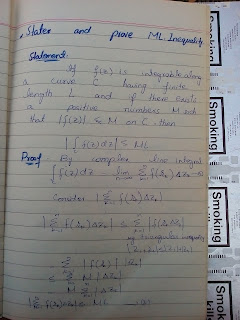
state and prove ML-inequality

ML-inequality

state and prove cauchy fundamental theorem

cauchy fundamental theorem

application of cauchy fundamental theorem
complex integration


locus of a point,curve,closed curve

simple curve,smooth curve ,piecewise curve, contour

complex line integral

complex line integral

evaluate line integral

evaluate line integral

line integral 

properties of integral


Complex Analysis Notes ,Advanced mathematics part 2, Handwritten Notes


circle

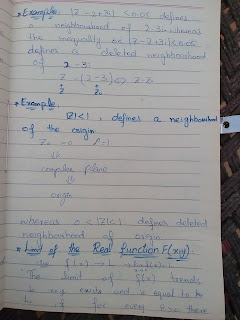
disk and neighborhood

limits of real functions

graphic representation of limits

criteria for non-existance of limit

limit don't exist

limit exist and unique

real and imaginary part of limit

compute limit

compute limit

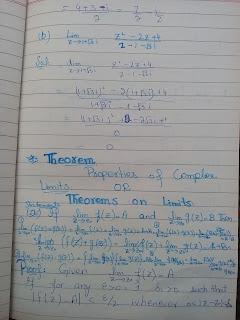
Properties of complex limits

theorems of limits

limits theorems

continuity

example of continuity

differenbility

if f(z) is differentiable then f(x) is continuous

analytic function at a point ,analytic in a domain

entire function, singular points

conjugate of function is not analytic,cauchy-Riemann equations or CR's equations

criteria for non-analytically

importants point about analyticty

sufficient condition for differentability

function is analytic at origin

harmonic function/potential function,harmonic conjugate function

obtain conjugate and the original function

example of harmonic function

cr equation in polar form

analytical function with constant modulus is constant

function is analytic and its derivative is zero ,is this constant?

analytic test

complex exponential function

derivative,conjugate,argument of complex function

modulus ,algebraic properties of complex exponential function,periodic function

exponential function is periodic

theorems related to periodicity of complex exponential function

complex logarithmic function

algebraic properties and principal value of complex logarithmic function

logarithmic function is inverse of exponential function

analyticity of principal branch of complex logarithmic function

complex powers ,principal value of complex powers

complex trigonometric functions

periodicity 

Featured posts

Exploring Mixed-Type Partial Differential Equations: Analysis and Applications☺☺, Mathematical Research

 Exploring Mixed-Type Partial Differential Equations: Analysis and Applications☺☺  Introduction Mixed-type partial differential equations (P...

popular posts