The Gap Between Quantum Mechanics and Abstract Algebra, Mathematics Research

 Outline:

1. Introduction to Quantum Mechanics and Abstract Algebra

  •     Understanding Quantum Mechanics
  •       Principles of Quantum Mechanics
  •         Wave-particle duality
  •         Superposition
  •       Applications of Quantum Mechanics
  •         Quantum computing
  •        Quantum cryptography
  •     Introduction to Abstract Algebra
  •      Basic Concepts
  •         Groups
  •        Rings
  •       Applications of Abstract Algebra
  •         Cryptography
  •         Error-correcting codes
  •        

2. Bridging the Gap: Quantum Mechanics and Abstract Algebra

  •    Mathematical Formalism in Quantum Mechanics
  •      State Vectors and Hilbert Spaces
  •       Operators in Quantum Mechanics
  •         Linear operators
  •         Hermitian operators
  •    Algebraic Structures in Quantum Mechanics
  •       Operator Algebras
  •       Symmetry Groups
  •         Unitary groups
  •         PoincarĂ© group


3. Quantum Information Theory and Abstract Algebra

  •     Entanglement and Algebraic Structures
  •       Entanglement in Quantum Mechanics
  •       Entanglement and Tensor Products
  •     Quantum Error Correction and Group Theory
  •       Stabilizer Codes
  •       Group Representation Theory


4. Conclusion

  •     The Intersection of Quantum Mechanics and Abstract Algebra
  •       Importance in Modern Physics
  •       Potential Future Developments


The Gap Between Quantum Mechanics and Abstract Algebra


Quantum mechanics and abstract algebra are two fundamental areas of study in modern physics and mathematics, respectively. While they may seem distinct at first glance, there exists a deep and intriguing connection between them that has captivated the minds of researchers for decades.


1. Introduction to Quantum Mechanics and Abstract Algebra


Understanding Quantum Mechanics


Quantum mechanics, the branch of physics that deals with the behavior of particles at the smallest scales, introduces us to a world where conventional rules no longer apply. At the heart of quantum mechanics lie principles such as wave-particle duality and superposition, which challenge our classical understanding of the universe.


Introduction to Abstract Algebra


Abstract algebra, on the other hand, is a branch of mathematics concerned with algebraic structures such as groups, rings, and fields. It provides a framework for understanding and manipulating abstract mathematical objects, laying the groundwork for various applications in mathematics and beyond.


2. Bridging the Gap: Quantum Mechanics and Abstract Algebra


Mathematical Formalism in Quantum Mechanics


To understand the connection between quantum mechanics and abstract algebra, we must delve into the mathematical formalism that underpins quantum theory. State vectors, often represented as vectors in complex Hilbert spaces, describe the quantum states of physical systems. Operators, which act on these state vectors, play a crucial role in defining observables and transformations in quantum mechanics.


Algebraic Structures in Quantum Mechanics


Interestingly, the mathematical structures that arise in quantum mechanics bear a striking resemblance to those studied in abstract algebra. Operator algebras, for instance, provide a mathematical framework for representing physical observables and operations. Moreover, symmetry groups, such as the unitary and Poincaré groups, encode fundamental symmetries of physical systems and find applications in quantum field theory and particle physics.


3. Quantum Information Theory and Abstract Algebra


Entanglement and Algebraic Structures


Entanglement, a unique feature of quantum mechanics where the properties of particles become intertwined, has deep connections to algebraic structures. The study of entanglement involves understanding how composite quantum systems can be described using tensor products of state spaces, drawing parallels to algebraic concepts such as direct sums and tensor products.


Quantum Error Correction and Group Theory


In the realm of quantum information theory, abstract algebra plays a crucial role in the development of error-correcting codes and fault-tolerant quantum computing. Stabilizer codes, for instance, rely on group-theoretic techniques to encode quantum information in a robust and error-resistant manner. Moreover, group representation theory provides insights into the structure and properties of quantum error-correcting codes.


4. Conclusion


In conclusion, the relationship between quantum mechanics and abstract algebra runs deep, permeating various areas of modern physics and mathematics. By bridging the gap between these two seemingly disparate fields, researchers have unlocked new avenues for exploration and discovery. As we continue to unravel the mysteries of the quantum world, the insights gleaned from abstract algebra will undoubtedly play a crucial role in shaping our understanding of the universe.


The Gap between Quantum Mechanics and Abstract Algebra

World of fractals, Mathematics Research

  Fascinating World of Fractals: A Mathematical Journey


Introduction 

Mathematics is a vast and captivating field that encompasses a wide range of topics, from algebra and calculus to geometry and statistics. However, one area that has gained significant attention in recent years is the study of fractals. Fractals are intricate and infinitely complex geometric shapes that exhibit self-similarity at various scales. They have become a trending topic in mathematics due to their mesmerizing beauty and their applications in various fields, including computer graphics, physics, and even art.


In this blog post, we will delve into the captivating world of fractals, exploring their origins, properties, and applications. We will also discuss some of the most famous fractals, such as the Mandelbrot set and the Julia set, and explain how they are generated. So, fasten your seatbelts as we embark on a mathematical journey that will take us deep into the realm of fractals.


1. What are Fractals?

To understand fractals, we must first grasp the concept of self-similarity. Unlike traditional geometric shapes, such as circles or squares, fractals exhibit self-similarity, meaning that they possess similar patterns or structures at different scales. This property allows fractals to be infinitely complex, with intricate details repeating themselves at various levels of magnification.


We will explore the mathematical definition of fractals, highlighting their key characteristics, such as fractional dimensionality and infinite detail. Additionally, we will discuss the concept of fractal dimension, which measures the complexity of a fractal shape.


2. The Beauty of Fractals 

Fractals are not only mathematically intriguing but also visually stunning. We will delve into the aesthetic appeal of fractals, discussing their intricate patterns, mesmerizing colors, and infinite complexity. Through captivating images and visual examples, we will showcase the breathtaking beauty of fractals, which has captivated mathematicians, artists, and enthusiasts alike.


3. Famous Fractals: The Mandelbrot Set 

One of the most famous fractals is the Mandelbrot set, named after the mathematician Benoit Mandelbrot. We will explore the origins of the Mandelbrot set, its mathematical definition, and the process of generating its intricate patterns. Through visual examples, we will demonstrate the mesmerizing complexity and infinite detail of this iconic fractal.


4. Famous Fractals: The Julia Set 

Another renowned fractal is the Julia set, which is closely related to the Mandelbrot set. We will explain the concept of the Julia set, its mathematical formulation, and the methods used to generate its intricate patterns. By comparing and contrasting the Julia set with the Mandelbrot set, we will highlight the unique properties and visual differences between these two captivating fractals.


5. Applications of Fractals 

Fractals have found numerous applications in various fields, including computer graphics, physics, biology, and even art. We will explore some of the practical uses of fractals, such as generating realistic landscapes, simulating natural phenomena, and creating visually appealing artwork. By showcasing real-world examples, we will demonstrate how fractals have revolutionized these fields and continue to inspire new discoveries.


Conclusion 

Fractals have emerged as a trending topic in mathematics due to their captivating beauty, infinite complexity, and practical applications. From the mesmerizing patterns of the Mandelbrot set to the intricate structures of the Julia set, fractals have captivated mathematicians, artists, and enthusiasts alike. Their self-similarity and infinite detail make them a fascinating subject of study, pushing the boundaries of our understanding of geometry and mathematics.


As we conclude our mathematical journey into the world of fractals, we hope to shed light on the allure and significance of these intricate shapes. Whether you are a mathematician, an artist, or simply someone curious about the wonders of mathematics, exploring the realm of fractals will undoubtedly leave you in awe of the infinite beauty and complexity that can arise from simple mathematical equations.

Quantum computing in the Era of AI, Mathematics Research

 Unveiling the Revolutionary Potential of Quantum Computing in the Era of AI: Exploring the Synergy Between the Next Frontiers


Introduction


In the exponentially evolving landscape of technology, two transformative fields, quantum computing and artificial intelligence (AI), have emerged as game-changers. While quantum computing holds the key to unprecedented computational power, AI enables us to extract knowledge and insights from abundant data. Together, these cutting-edge technologies possess the potential to revolutionize industries, solve complex problems, and reshape our understanding of the world. In this article, we delve into the synergy between quantum computing and AI, unveiling their immense possibilities and exploring their far-reaching implications.


Quantum Computing: A Paradigm Shift in Processing Power


Traditional computing systems use bits, representing information as either 0s or 1s, to perform computations. Quantum computing, on the other hand, utilizes quantum bits, or qubits, that can exist in multiple states simultaneously due to a phenomenon called superposition. This unique property allows quantum computers to perform computations exponentially faster than their classical counterparts, unlocking the potential to solve problems that are currently infeasible.


Harnessing Quantum Computing and AI for Enhanced Machine Learning


One of the most promising applications of quantum computing lies in enhancing AI and machine learning algorithms. By leveraging the computational supremacy of quantum systems, AI algorithms can process and analyze vast amounts of data more efficiently, ultimately leading to more accurate predictions and improved decision-making.


Quantum Machine Learning (QML) is an emerging field that aims to combine quantum algorithms with classical machine learning techniques. QML harnesses quantum computing's ability to process complex data sets, identifying intricate patterns that classical machine learning algorithms may struggle to discern. This amalgamation has the potential to unlock groundbreaking advancements in computer vision, natural language processing, and other AI applications.


The potential of QML becomes evident when considering the obstacle of the "curse of dimensionality." Quantum algorithms can operate in a high-dimensional Hilbert space, offering a solution to the challenges posed by exponentially increasing feature sets. Such computational efficiency can empower AI models with greater predictive accuracy.


Quantum AI Algorithms for Optimization and Simulation


Optimization and simulation problems play a critical role in various industries, from designing complex manufacturing processes to optimizing supply chain logistics. Quantum computing can significantly enhance optimization algorithms by exploring a vast number of possibilities simultaneously.


Quantum Optimization Algorithms (QOAs) enable the expedited resolution of complex optimization problems by leveraging quantum algorithms such as the Quantum Approximate Optimization Algorithm (QAOA) and the Quantum Phase Estimation Algorithm (QPEA). These algorithms leverage the efficiency of qubits' superposition and entanglement properties to explore the search space more thoroughly, finding optimal or near-optimal solutions more quickly.


Simulation tasks can also benefit immensely from the power of quantum computing. Quantum Simulations, facilitated by the Quantum Circuit Born Machine (QCBM) and the Variational Quantum Eigensolver (VQE), allow researchers to simulate and analyze quantum systems more accurately than traditional methods. This has immense implications for industries such as drug discovery, materials science, and climate modeling.


Ethical Considerations and Security Challenges


As quantum computing and AI continue to evolve, ethical considerations and security challenges come to the forefront. The power of quantum computing may break existing cryptographic algorithms, posing a threat to data security. Researchers and stakeholders need to develop quantum-resistant cryptography techniques to safeguard sensitive information in a post-quantum era.


Furthermore, the rapid advancements in AI raise concerns about bias, privacy, and transparency. As quantum-enhanced AI algorithms become more sophisticated, it is crucial to ensure they are built with ethical guidelines in mind. Transparent and explainable AI frameworks must be developed to mitigate potential biases and promote fairness, trust, and accountability.


Conclusion


Quantum computing and AI are two frontier technologies poised to reshape the future. The synergy between these fields holds immense potential for advancements in machine learning, optimization, and simulation. Researchers, engineers, and policymakers must collaborate to harness the advantages these technologies offer, address ethical considerations, and overcome security challenges. As we navigate towards a future powered by quantum computing and AI, the boundaries of what is possible will be redrawn, propelling humanity into uncharted realms of discovery, innovation, and transformation.

Beauty of Abstract algebra, Mathematics Research

Beauty of Abstract algebra


 Introduction


In the realm of mathematics, one concept stands out for its elegance and depth - Topological spaces. This abstract mathematical framework, which deals with the notion of closeness and continuity, has widespread applications across various scientific disciplines. In this blog post, we will delve into the intriguing world of topological spaces, understanding their key characteristics, properties, and real-world significance.


What are Topological Spaces?

At its core, a topological space is a set equipped with a specific structure that captures the notion of proximity between its elements. It defines what it means for a set of points to be "near" each other without the need for a defined distance metric. This level of abstraction grants topological spaces their versatility and applicability in diverse fields such as physics, computer science, and data analysis.


Key Definitions and Concepts

a. Open Sets: 

In a topological space, subsets called open sets possess a crucial role. An open set contains all points around a given point such that any point within it is still considered close enough to belong to the set. These open sets establish the foundation for continuity and convergence within the space.


b. Topological Continuity: 

One of the fundamental concepts in topological spaces is continuity. A function between two topological spaces is considered continuous if the pre-image of an open set in the target space is open in the domain space. Continuity provides a natural link between different topological spaces, allowing us to map and transform one space into another while preserving its underlying structure.


Common Examples of Topological Spaces

a. Euclidean Spaces: 

The familiar Euclidean spaces in two and three dimensions are classic examples of topological spaces. In these spaces, distance and proximity are defined using the standard Euclidean metric, but we can also abstractly represent them as topological spaces by defining their open sets.


b. Discrete Spaces: 

A discrete topological space treats each point as an isolated entity, considering singletons as open sets. This implies that any subset of the space can be open, leading to unique properties compared to other topological spaces.


Topological Invariants

Topological spaces are known for their invariance under certain transformations. The concepts of homeomorphism and homotopy play a vital role in identifying and classifying topological spaces. A homeomorphism is a bijective function between two topological spaces and their inverses, while homotopy deals with the continuous deformation of one space into another.


Applications of Topological Spaces

a. Network Theory: 

In the study of complex networks, topological spaces are instrumental in understanding connectivity, clustering, and the emergence of patterns in network structures.


b. Data Analysis:

 Topological data analysis (TDA) is an emerging field that applies topological concepts to analyze and visualize complex datasets. TDA can reveal insights into the shape and structure of data, enabling data-driven decision-making in various domains.


Conclusion


Topological spaces offer an enthralling journey into the heart of abstract mathematics, where the notion of proximity takes center stage. Their profound impact extends beyond pure mathematics into numerous scientific domains, providing a powerful framework to study connectivity, continuity, and transformations. By exploring the fascinating world of topological spaces, we gain a deeper appreciation for the beauty and universality of mathematical concepts and their real-world applications.

Exploring the Fascinating Realm of Graph Theory , Mathematics Research


 Exploring the Fascinating Realm of Graph Theory


Introduction:

Mathematics is a vast and intriguing field, with numerous sub-disciplines and advanced topics that continue to captivate researchers and mathematicians alike. One such area is Topological Graph Theory, which combines the principles of graph theory with the abstract concepts of topology. In this blog post, we will delve into the Topological Graph Theory and explore why it stands out as an exceptionally fascinating and important branch of advanced mathematics.

Topological Graph Theory is the study of the properties of graphs through the lens of topology. Graph theory deals with the study of discrete structures called graphs, which consist of vertices connected by edges. Top on the other hand, focuses on Graph Theory and aims to understand and analyze the topological features of graphs, such as connectivity, planarity, colorability, and embedding properties. It explores questions like how a graph can be embedded on a surface, what kinds of knots can be formed by graphs, and how graphs can be transformed while preserving certain topological properties.

 Importance:

Although Topological Graph Theory may appear abstract and theoretical at first glance, it has important real-world applications. For example:

1. Network Optimization: 

Topological Graph Theory provides insights into optimizing various types of networks, such as computer networks, transportation systems, and social networks. Understanding the topological properties of graphs can help in designing efficient, robust, and fault-tolerant networks.

2. DNA Research: 

Topological Graph Theory has found applications in understanding and analyzing DNA molecules. DNA can be represented as a graph, and topological properties can shed light on DNA recombination, and ent.

3. Map Coloring:

 The Theorem, a well-known result in Topological Graph Theory, states that one a be colored using at most four colors in such a way that adjacent regions have the same color. This theorem has practical applications in computer science, cartography, and scheduling problems.

Not and Challenges:

Topological Graph Theory has witnessed numerous remarkable results and conjectures, contributing to the advancement of mathematics as a whole. Some notable achievements include:

1. The Jordan Curve Theorem: 

This theorem, proven by Camille Jordan in 1887, states that every simple closed curve divides the plane into connected components, an interior, and an exterior.

2. The Four-Color Theorem:  

As mentioned earlier, this theorem asserts that any map on a plane can be colored using at most four colors. It was famously proven using extensive computer-assisted methods in 1976.

While Topological Graph Theory has made significant strides, there are still many conjectures waiting to be explored. For instance, the Crossingjecture, which proposes that every graph can be drawn on a plane with a minimum number of crossings, remains unproven.

Conclusion:

Topological Graph Theory serves as a captivating intersection between graph theory and topology, offering insights into the behavior of graphs through a topological lens. network optimization,, and map its practical As mathematicians continue to explore and unravel its mysteries, Topological Graph Theory promises to unlock new possibilities, challenging our understanding of the fundamentals underlie the world around us.

Numbers | Basic Mathematics , Mathematics Explained
Numbers

 Numbers should be distinguished from numerals, the symbols used to represent numbers. The Egyptians invented the first ciphered numeral system, and the Greeks followed by mapping their counting numbers onto Ionian and Doric alphabets. Roman numerals, a system that used combinations of letters from the Roman alphabet, remained dominant in Europe until the spread of the superior Hindu–Arabic numeral system around the late 14th century, and the Hindu–Arabic numeral system remains the most common system for representing numbers in the world today. The key to the effectiveness of the system was the symbol for zero, which was developed by ancient Indian mathematicians around 500 AD.


what is number?

A number is an arithmetic value used for representing the quantity and used in making calculations. A written symbol like “3” which represents a number is known as numerals. A number system is a writing system for denoting numbers using digits or symbols in a logical manner.


Types of Numbers

According to the properties and how they are represented in the number line, the numbers are classified into different types. Each classification of number is provided herewith description, properties, and examples to understand it in a better way. The different types of numbers are as follows:


Natural Numbers

Natural numbers are also called “counting numbers” which contains the set of positive integers from 1 to infinity. The set of natural numbers is represented by the letter “N”. The natural number set is defined by:


N = {1, 2, 3, 4, 5, ……….}


Examples: 35, 59, 110, etc.


Properties of Natural Numbers:


  • Addition of natural numbers is closed, associative, and commutative.
  • Natural Number multiplication is closed, associative, and commutative.
  • The identity element of a natural number under addition is zero.
  • The identity element of a natural number under Multiplication is one.


Whole Numbers

Whole numbers are also known as natural numbers with zero. The set consists of non-negative integers where it does not contain any decimal or fractional part. The whole number set is represented by the letter “W”. The natural number set is defined by:


W = {0,1, 2, 3, 4, 5, ……….}


Examples: 67, 0, 49, 52, etc.


Properties of Whole Numbers:


  • Whole numbers are closed under addition and multiplication.
  • Zero is the additive identity element of the whole numbers.
  • 1 is the multiplicative identity element.
  • It obeys the commutative and associative property of addition and multiplication.
  • It satisfies the distributive property of multiplication over addition and vice versa.


Real Numbers

Any number such as positive integers, negative integers, fractional numbers or decimal numbers without imaginary numbers are called the real numbers. It is represented by the letter “R”.


Examples: ¾, 0.333, √2, 0, -10, 20, etc.


Properties of Real Numbers:


  • Real Numbers are commutative, associate, and distributive under addition and multiplication.
  • Real numbers obey the inverse property.
  • Additive and multiplicative identity elements of real numbers are 0 and 1, respectively.


Rational Numbers

Any number that can be written in the form of p/q, i.e., a ratio of one number over another number is known as rational numbers. A rational number can be represented by the letter “Q”.


Examples: 7/1, 10/2, 1/1, 0/1, etc.


Properties of Rational Numbers:


  • Rational numbers are closed under addition, subtraction, multiplication, and division.
  • It satisfies commutative and associative property under addition and multiplication.
  • It obeys distributive property for addition and subtraction.


Irrational Numbers

The number that cannot be expressed in the form of p/q. It means a number that cannot be written as the ratio of one over another is known as irrational numbers. It is represented by the letter ”P”.


Examples: √2, Ï€, Euler’s constant, etc


Properties of Irrational Numbers:


  • Irrational numbers do not satisfy the closure property.
  • It obeys commutative and associative property under addition and multiplication.
  • Irrational Numbers are distributive under addition and subtraction.


Complex Numbers

A number that is in the form of a+bi is called complex numbers, where “a and b” should be a real number and “i” is an imaginary number.


Examples: 4 + 4i, -2 + 3i, 1 +√2i, etc


Properties of Complex Numbers:


The following properties hold for the complex numbers:


  • Associative property of addition and multiplication.
  • Commutative property of addition and multiplication.
  • Distributive property of multiplication over addition.


Imaginary Numbers

The imaginary numbers are categorized under complex numbers. It is the product of real numbers with the imaginary unit “i”. The imaginary part of the complex numbers is defined by Im (Z).


Examples: √2, i2, 3i, etc.


Properties of Imaginary Numbers:


Imaginary Numbers has an interesting property. It cycles through 4 different values each time when it is under multiplication operation.


1 × i = i

i × i = -1

-1 × i = -i

-i × i = 1

So, we can write the imaginary numbers as:


i = √1

i2 = -1

i3 = -i

i4 = +1

i4n = 1

i4n-1= -i


Integers

Integers are defined as the set of all whole numbers with a negative set of natural numbers. The integer set is represented by the symbol “Z”. The set of integers is defined as:


Z =  {-3, -2, -1, 0, 1, 2, 3}


Examples: -52, 0, -1, 16, 82, etc.


Properties of Integers:


  • Integers are closed under addition, subtraction, and multiplication.
  • The commutative property is satisfied for addition and multiplication of integers.
  • It obeys the associative property of addition and multiplication.
  • It obeys the distributive property for addition and multiplication.
  • Additive identity of integers is 0.
  • Multiplicative identity of integers is 1.

Complex Analysis Notes part 3, Advanced (Handwritten notes) mathematics

modulus

 
zeros, derivative of complex trigonometric functions,complex hyperbolic functions

derivative of complex hyperbolic functions,some important relations of complex hyperbolic functions

inverse sine

inverse sine

inverse of cosine and tangent

inverse hyperbolic functions


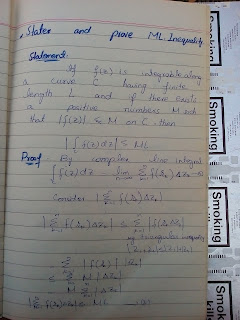
state and prove ML-inequality

ML-inequality

state and prove cauchy fundamental theorem

cauchy fundamental theorem

application of cauchy fundamental theorem
complex integration


locus of a point,curve,closed curve

simple curve,smooth curve ,piecewise curve, contour

complex line integral

complex line integral

evaluate line integral

evaluate line integral

line integral 

properties of integral


Complex Analysis Notes ,Advanced mathematics part 2, Handwritten Notes


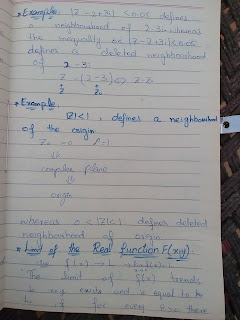
circle

disk and neighborhood

limits of real functions

graphic representation of limits

criteria for non-existance of limit

limit don't exist

limit exist and unique

real and imaginary part of limit

compute limit

compute limit

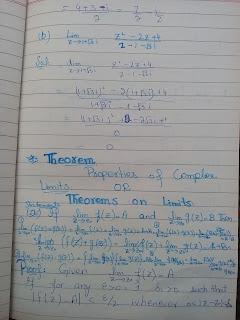
Properties of complex limits

theorems of limits

limits theorems

continuity

example of continuity

differenbility

if f(z) is differentiable then f(x) is continuous

analytic function at a point ,analytic in a domain

entire function, singular points

conjugate of function is not analytic,cauchy-Riemann equations or CR's equations

criteria for non-analytically

importants point about analyticty

sufficient condition for differentability

function is analytic at origin

harmonic function/potential function,harmonic conjugate function

obtain conjugate and the original function

example of harmonic function

cr equation in polar form

analytical function with constant modulus is constant

function is analytic and its derivative is zero ,is this constant?

analytic test

complex exponential function

derivative,conjugate,argument of complex function

modulus ,algebraic properties of complex exponential function,periodic function

exponential function is periodic

theorems related to periodicity of complex exponential function

complex logarithmic function

algebraic properties and principal value of complex logarithmic function

logarithmic function is inverse of exponential function

analyticity of principal branch of complex logarithmic function

complex powers ,principal value of complex powers

complex trigonometric functions

periodicity 

Featured posts

Exploring Mixed-Type Partial Differential Equations: Analysis and Applications☺☺, Mathematical Research

 Exploring Mixed-Type Partial Differential Equations: Analysis and Applications☺☺  Introduction Mixed-type partial differential equations (P...

popular posts